
No products in the cart.
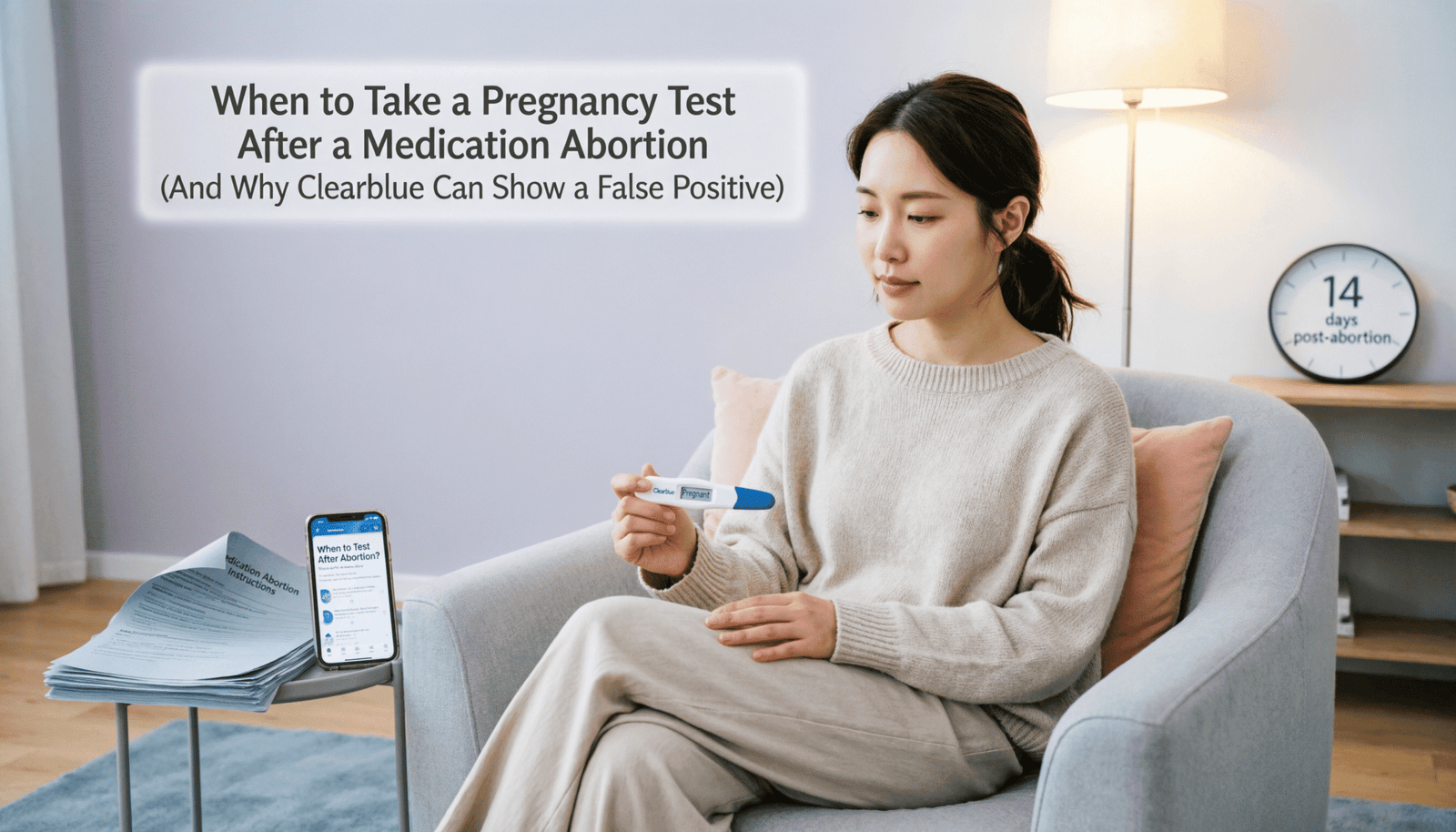
When to Take a Pregnancy Test After a Medication Abortion (And Why Clearblue Can Show a False Positive)
Quick Overview
- Wait at least 3 weeks after a medication abortion before taking a pregnancy test.
- Over-the-counter tests like Clearblue are highly sensitive and may show a false positive even when the abortion has worked.
- A low-sensitivity pregnancy test (1000 mIU/mL) is recommended for post-abortion follow-up in the UK.
- Always follow the guidance provided by your abortion care provider for accurate results and next steps.
Introduction
If you’ve recently had a medication abortion—or are considering one—you may be wondering how to confirm it worked.
One of the most common questions people ask is:
“Can I just take a Clearblue test to check if the abortion worked?”
The short answer is: No, not immediately.
Standard pregnancy tests are designed to detect pregnancy, not confirm that it has ended. Because of how pregnancy hormones behave after abortion, using a typical shop-bought test too soon can lead to confusion and unnecessary anxiety.
In this UK-based guide, we’ll explain:
- What happens to hCG levels after a medication abortion
- Why high-sensitivity tests can show false positives
- Why low-sensitivity tests are recommended in UK abortion care
- What to do if your test is still positive
- When to seek medical advice
This content is medically informed, evidence-based, and aligned with UK clinical guidance.
What Happens to hCG After a Medication Abortion?
Pregnancy tests work by detecting human chorionic gonadotropin (hCG), often called the pregnancy hormone.
After a successful medication abortion:
- hCG levels begin to fall quickly.
- Levels typically drop by 80–98% within the first 1–2 weeks.
- However, small amounts of hCG can remain in the body for up to 6–8 weeks.
Because modern pregnancy tests are extremely sensitive, they can detect even very low levels of hCG—long after the pregnancy has ended.
This is why testing too early can result in a positive test even when the abortion was successful.
Why Clearblue and Other Shop-Bought Tests Can Show a False Positive
Most supermarket pregnancy tests, including Clearblue, detect hCG at levels as low as 10–25 mIU/mL.
These tests are excellent for detecting early pregnancy—but that sensitivity becomes a problem after abortion.
Here’s why:
- Even low, declining levels of hCG can trigger a positive result.
- You may see a faint line or a digital “Pregnant” result.
- This does not necessarily mean the abortion failed.
High-sensitivity tests cannot distinguish between:
- A new, ongoing pregnancy
- Or leftover hormone from a pregnancy that has already ended
That’s why they are not recommended for post-abortion confirmation.
When Should You Take a Pregnancy Test After Abortion?
In the UK, clinical providers generally recommend:
Wait at Least 3 Weeks
Testing before 3 weeks significantly increases the risk of a false positive.
Ideally Test at 3–4 Weeks
This timeframe allows hCG levels to drop enough for a meaningful result.
Avoid Testing Within 7–14 Days
Almost all tests during this period will still show positive.
If you test too early, you may create unnecessary worry.
What Is a Low-Sensitivity Pregnancy Test?
A low-sensitivity pregnancy test is specifically designed for post-abortion follow-up.
Unlike standard tests, it detects only higher levels of hCG (around 1000 mIU/mL).
This means:
- It will not react to small, leftover hormone levels.
- It is better suited to confirm whether pregnancy tissue has passed.
- It reduces the risk of false positives after abortion.
Low-sensitivity tests are commonly used by UK abortion providers, including:
- National Health Service (NHS)
- British Pregnancy Advisory Service (BPAS)
- MSI Reproductive Choices UK
- NUPAS
These tests are usually included in post-abortion care packages and are considered best clinical practice.
How Do Low-Sensitivity Tests Work?
Most low-sensitivity tests:
- Show one line if hCG is below 1000 mIU/mL (abortion likely complete)
- Show two lines if hCG remains high (further evaluation may be needed)
They are not early pregnancy tests.
They are designed only for post-treatment confirmation.
Common Questions About Pregnancy Testing After Abortion
1. How long does hCG stay in your system?
hCG can remain detectable for up to 6–8 weeks, depending on:
- Gestational age
- Individual hormone metabolism
- Whether the abortion was medical or surgical
2. Can you still test positive 3 weeks after abortion?
Yes. Even at 3 weeks, some people may still receive a positive result on a high-sensitivity test.
This does not automatically mean the abortion failed.
3. What is the normal hCG level for a non-pregnant person?
A non-pregnant person typically has less than 5 mIU/mL of hCG.
Standard home tests detect much lower levels than this threshold.
4. Why is my pregnancy test still positive 6 weeks after abortion?
Possible reasons include:
- Lingering hCG that has not fully cleared
- Incomplete abortion
- Rarely, ongoing pregnancy
If your test remains positive at 6 weeks, contact your provider for advice.
5. How do I know if my abortion is complete?
Signs often include:
- Heavy bleeding and clots after taking the medication
- Strong cramping
- Reduction in pregnancy symptoms (nausea, breast tenderness)
- A negative low-sensitivity pregnancy test at 3–4 weeks
If unsure, consult your provider or consider an ultrasound.
After a Positive Test: What Are Your Options?
If your pregnancy test is positive, your next step depends on your situation.
You may:
- Wait and repeat the test in one week
- Contact your abortion provider
- Have an ultrasound if advised
If you are still within 10 weeks of pregnancy, medication abortion remains a legal and effective option in England and Wales under UK law, following proper medical consultation.
The earlier treatment is provided, the more straightforward and effective it tends to be.
When to Seek Medical Advice Urgently
Contact a healthcare professional immediately if you experience:
- Severe abdominal pain that does not improve
- Heavy bleeding (soaking 2 or more pads per hour for 2 hours)
- Fever above 38°C lasting more than 24 hours
- Foul-smelling vaginal discharge
Your safety and wellbeing should always come first.
TL;DR: Post-Abortion Pregnancy Testing Guide
- Wait at least 3 weeks before testing.
- Avoid Clearblue or other high-sensitivity tests for confirmation.
- Use a low-sensitivity test (1000 mIU/mL) if provided by your clinic.
- False positives are common in the first month after abortion.
- Contact your provider if you are unsure about your result.
Final Thoughts
It’s completely normal to feel uncertain after a medication abortion. Pregnancy hormones do not disappear immediately, and highly sensitive tests can give misleading results if used too soon.
Waiting the recommended time and using the correct test can prevent unnecessary stress.
For personalised advice, always follow the instructions provided by your registered healthcare provider. If you have concerns, reach out to a qualified medical professional for support.